
Premier Biogas Project Contractor: Mastering GFS Tanks and UASB Process-Center Enamel
Global livestock inventories such as swine remain stable. The US has developed technical models represented by integrated crop-livestock systems with on-field application and Comprehensive Nutrient Management Plans; Denmark, the Netherlands, and others have developed centralized biogas projects with digestate application systems. China's large-scale farms still have considerable room for improvement in supporting biogas project coverage, and digestate resource utilization rates lag behind advanced European levels. Greenhouse gas emissions from livestock account for a significant proportion of total global anthropogenic emissions, making manure management a critical battleground for agricultural carbon reduction. Latin American countries started later in manure management but are accelerating relevant infrastructure development.
As the global imperative for carbon reduction drives the adoption of sophisticated waste-to-energy technologies, the role of a professional Biogas Project Contractor becomes vital. Bridging the gap between regional environmental policy and operational success requires advanced technical expertise. To achieve these goals, implementing proven reaction technologies like the UASB Process is a foundational step in any modern facility design.
What is UASB Process?
UASB, or Upflow Anaerobic Sludge Blanket Reactor, is the benchmark mainstream technology for medium-to-high concentration soluble organic wastewater treatment. It requires no mechanical mixing or media carriers, relying on the upward flow of wastewater to suspend and expand granular sludge within the reactor, forming a stable sludge bed layer. Highly active anaerobic granular sludge efficiently degrades pollutants, with excellent settleability and high microbial concentration. UASB innovatively integrates reaction, sedimentation, and gas-liquid-solid separation functions, simplifying the anaerobic treatment process with advantages of high efficiency, energy savings, and compactness. It is widely used in various medium-to-high concentration soluble organic wastewater treatment applications.
While the UASB reactor provides the biological engine for waste conversion, the source and characteristic of the wastewater dictate the configuration of the entire treatment train. Successfully managing these inputs requires a thorough understanding of agricultural and industrial pollutant profiles. This knowledge ensures that the system is optimized for its specific waste stream.
Livestock Wastewater Sources
Livestock wastewater is the core agricultural pollution wastewater from large-scale poultry, livestock, and aquaculture operations, generated primarily during farming operations and facility cleaning. Poultry and livestock wastewater is the main component, including wash water from pig, cattle, and poultry housing, manure and urine seepage, and facility washdown-rich in livestock metabolic residues. Aquaculture wastewater comes from periodic pond water exchange and pond cleaning, with feed residues and metabolic waste as pollutants. Wastewater is primarily generated in peri-urban and rural farming areas. Small-scale farmers lack adequate collection facilities, with wastewater discharged directly to land and water. Large-scale farms have collection systems for centralized treatment, with water production varying with production cycles and cleaning frequency.
Efficiently containing such high-strength waste requires durable, high-performance infrastructure that can withstand corrosive environments over long periods. Demonstrating these capabilities in real-world, large-scale applications validates our commitment to environmental engineering excellence. Our landmark projects highlight how our custom storage and treatment systems solve complex pollution challenges.
Indonesia Palm Oil Biogas Project
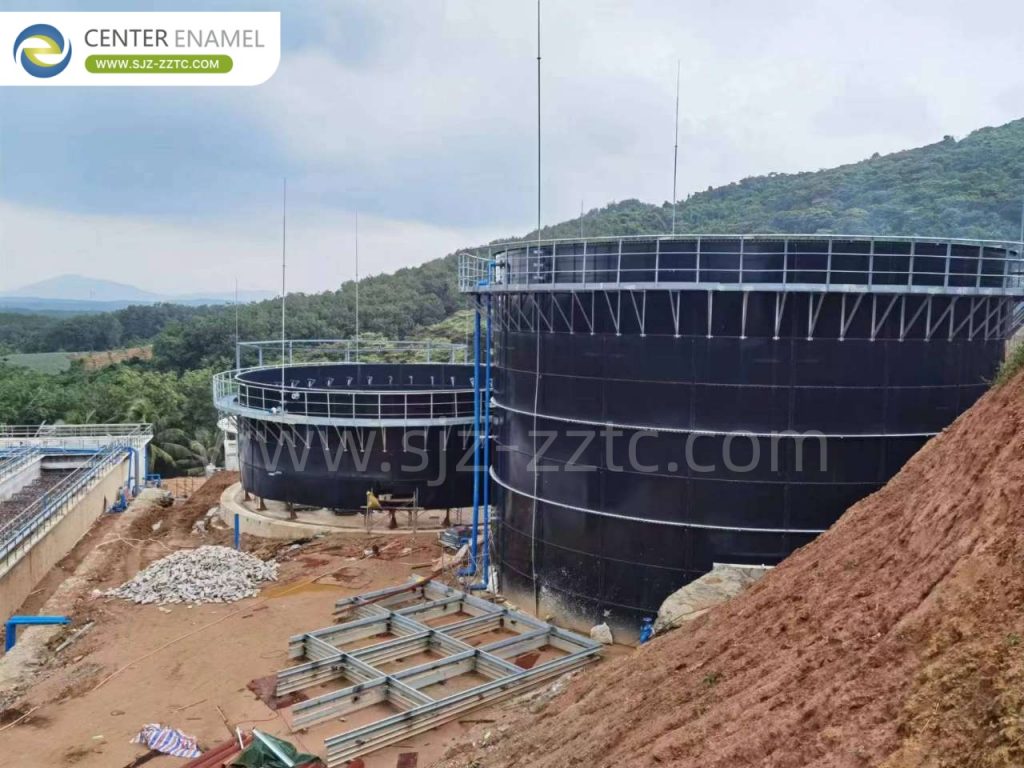
Specifically designed for high-concentration palm oil wastewater treatment with 3 GFS fermentation tanks, each 19.86 m diameter × 8.4 m height. Installation began November 2009 with only 7 construction personnel, completing all tank assembly in 40 days-highly efficient and time-saving. Tanks are fitted with dual-membrane gas storage covers for POME anaerobic digestion-degrading organics and recovering biogas energy while eliminating palm industry pollution. This is an early benchmark POME biogas treatment project in Southeast Asia.
The successful delivery of projects like the Indonesia Palm Oil initiative is the culmination of decades of research, manufacturing innovation, and strategic industry growth. As an established leader in the field, we have transitioned from a specialized tank manufacturer to a comprehensive service provider. Our history reflects a steadfast commitment to delivering reliable environmental solutions.
Center Enamel Development History
Center Enamel has been deeply engaged in the environmental bolted storage equipment field for over 30 years. Starting with proprietary enamel anti-corrosion material technology, the company has gradually completed the full-industry-chain upgrade from a single tank manufacturer to a comprehensive environmental EPC service provider. Throughout its 30+ year history, the company has been recognized as a National High-Tech Enterprise, National Specialized and Sophisticated "Little Giant," Manufacturing Single Champion, and Provincial Green Factory. It has successfully delivered over 30,000 environmental projects globally, establishing itself as a leading enterprise in the global GFS tank storage industry. The company has fully integrated the entire chain from enamel frit R&D, intelligent environmental equipment manufacturing, to EPC project contracting-every business breakthrough has been achieved through proprietary core anti-corrosion technology.
Central to this global success is our proprietary material technology, which serves as the cornerstone of our durable and highly reliable product line. Ensuring the longevity of our tanks requires specialized formulations designed to resist severe chemical exposure. These innovations represent our dedication to advancing industry standards for material safety and performance.
Center Enamel Innovative Material Technology
Center Enamel has independently developed over 200 anti-corrosion enamel formulations, with proprietary double-sided double-layer enameling technology-GFS tank anti-corrosion service life exceeds 30 years-far surpassing concrete and ordinary equipment-suitable for global high-corrosion wastewater and biogas fermentation conditions.
To ensure comprehensive facility protection, we also provide diverse covering solutions tailored to different operational requirements. Whether for biogas collection or simple water storage, choosing the right roof is essential for maintenance efficiency and secondary contamination prevention. These versatile components round out our full-service approach to environmental engineering.
FRP Roof Cover Solution
FRP Roof is a general-purpose economical roof for atmospheric pressure storage tanks without air-tightness requirements, suitable for drinking water storage, agricultural irrigation water, firewater reserve, and general production wastewater temporary storage. It is available in two styles: flat and dome, allowing flexible selection based on tank specifications and site aesthetic requirements. The roof is integrally molded from resin and fiberglass, lightweight, with natural water resistance and mild acid/alkali corrosion resistance. It will not rust or rot in long-term humid environments, eliminating the frequent anti-corrosion maintenance required for metal roofs. The dome style features excellent drainage performance due to its curved structure, resisting water accumulation, dust buildup, snow load, and strong winds. The flat style facilitates the installation of maintenance walkways, level gauges, and vents on top, making inspection and operation convenient.
The product is fully insulated with no risk of galvanic corrosion, will not contaminate drinking water quality, and meets environmental standards for domestic water storage. The modular design with low individual component weight allows for simple on-site hoisting and assembly, offering high construction efficiency and affordable procurement and installation costs. It is only suitable for atmospheric pressure water storage tanks without biogas collection or pressurization requirements, and is not recommended for anaerobic fermentation gas-producing conditions. It is widely used in rural agricultural water storage tanks, industrial park firewater tanks, waterworks buffer tanks, and small to medium-sized domestic wastewater temporary storage facilities, making it a cost-effective general-purpose roof choice for conventional water storage applications.
Frequently Asked Questions (FAQ)
What are the key benefits of choosing Center Enamel as your Biogas Project Contractor?
Center Enamel offers over 30 years of global experience, providing end-to-end EPC services. We combine proprietary GFS tank technology with high-efficiency UASB processes to deliver turnkey biogas and wastewater projects, ensuring long-term operational success, regulatory compliance, and maximum energy recovery through professional, standardized project management.
Why are GFS Tanks recommended for biogas projects?
GFS tanks provide superior anti-corrosion performance, with a service life exceeding 30 years. Their factory-prefabricated, bolted modular design allows for rapid, efficient assembly in diverse climates. By preventing corrosion from high-ammonia and high-sulfide environments, they ensure robust containment and reduced maintenance, making them ideal for high-performance biogas power plant applications.
What makes the UASB Process ideal for industrial wastewater treatment?
The UASB process is a benchmark technology that offers efficient organic degradation and biogas production without needing mechanical mixers or media carriers. Its compact, integrated design for reaction, sedimentation, and separation minimizes capital and operational costs, providing a stable, high-efficiency solution for medium-to-high concentration industrial and agricultural wastewater.