
What Is Solid Waste Management? The Ultimate Guide to Sustainable Waste-to-Energy Solutions
Rapid global industrialization, population growth, and urbanization have triggered an unprecedented surge in municipal and industrial refuse generation. Every day, cities produce millions of tons of discarded materials that demand careful handling. Understanding and implementing robust strategies is vital for protecting public health, conserving natural resources, and mitigating climate change.
So, what is solid waste management? At its core, it is the systematic administration of the generation, segregation, collection, transfer, processing, and ultimate disposal of solid materials in a manner that minimizes environmental and health impacts. Today, forward-thinking cities are shifting away from traditional disposal methods and moving toward advanced resource recovery-particularly transforming organic solid waste into clean, renewable biogas.
Defining Solid Waste Management: Scope and Core Objectives
Solid waste management encompasses all activities required to handle refuse from its point of origin to its final destination. Refuse typically includes municipal solid waste (MSW) from households, commercial refuse, industrial byproducts, and agricultural residues.
The fundamental objectives of a modern management framework include:
Protection of Public Health: Preventing the spread of vector-borne diseases, pathogen proliferation, and toxic contamination in residential zones.
Environmental Preservation: Reducing greenhouse gas emissions, protecting local aquifers from leachate pollution, and conserving fragile ecosystems.
Resource Conservation: Maximizing recovery, recycling, and energy generation to transition toward a regenerative circular economy.
The Environmental and Economic Pitfalls of Traditional Disposal Methods
Historically, modern societies have relied heavily on two primary methods for managing solid waste: open dumping/landfilling and mass incineration. While straightforward in the short term, both approaches carry severe systemic flaws:
The Landfill Burden: Landfilling requires vast tracts of valuable land. As organic solid waste decomposes anaerobically under uncontrolled conditions, it generates massive volumes of methane-a potent greenhouse gas-alongside toxic liquid leachate that threatens groundwater supplies.
The Incineration Dilemma: Burning unseparated waste can release harmful dioxins, heavy metals, and particulate matter if flue gas treatment is inadequate. Furthermore, incineration destroys valuable organic nutrients that could otherwise be recovered and returned to agricultural soils.
These escalating environmental pressures have forced municipal planners and industrial operators to adopt cleaner, more sustainable alternatives.
Moving Toward a Circular Economy: The Hierarchy of Waste
Modern solid waste management is guided by the internationally recognized Waste Hierarchy, which prioritizes strategies from the most environmentally sound to the least desirable:
Prevention and Reduction: Minimizing waste generation at the source through smart manufacturing and consumer habits.
Reuse and Repair: Extending the lifespan of products and materials.
Recycling and Composting: Processing inorganic materials into raw manufacturing inputs and biological waste into compost.
Energy Recovery (Waste-to-Energy): Converting non-recyclable organic fractions into heat, electricity, or renewable fuels.
Disposal: Landfilling as an absolute last resort.
Within this framework, converting organic solid waste into biogas via anaerobic digestion stands out as a premier waste-to-energy solution.
Transforming Organic Solid Waste into Renewable Biogas Energy
A significant portion of municipal and agricultural solid waste consists of biodegradable organic matter, such as food scraps, yard waste, and animal manure. Instead of letting these materials rot in landfills, anaerobic digestion harnesses natural microbial processes inside sealed reactors to convert them into valuable energy.
The transformation yields two primary outputs:
Biogas: A clean-burning renewable gas composed primarily of methane and carbon dioxide. It can be directly combusted for heat and power generation or upgraded to biomethane for natural gas grid injection and vehicular transport.
Digestate: A nutrient-rich organic residue that serves as an exceptional bio-fertilizer, replacing chemical fertilizers and closing the agricultural nutrient loop.
Advanced Anaerobic Digestion Technology: The Power of CSTR Systems
To efficiently process complex solid waste streams into biogas, specialized engineered reactor configurations are required. Among them, the Continuous Stirred Tank Reactor (CSTR) stands out as the industry workhorse.
The Mechanism and Benefits of CSTR Systems
The CSTR system is specifically engineered for high-solids organic waste slurries and co-digestion applications. Equipped with robust mechanical or hydraulic mixing mechanisms, it ensures a uniform distribution of temperature, nutrients, and active microorganisms throughout the vessel.
This continuous agitation prevents crust formation, eliminates localized dead zones, and maximizes gas yields from high-solids feedstocks. By maintaining homogeneous conditions, CSTR technology guarantees stable, long-term biological performance even when handling complex or variable solid waste streams.
The Role of High-Performance GFS Storage Tanks in Solid Waste Biogas Plants
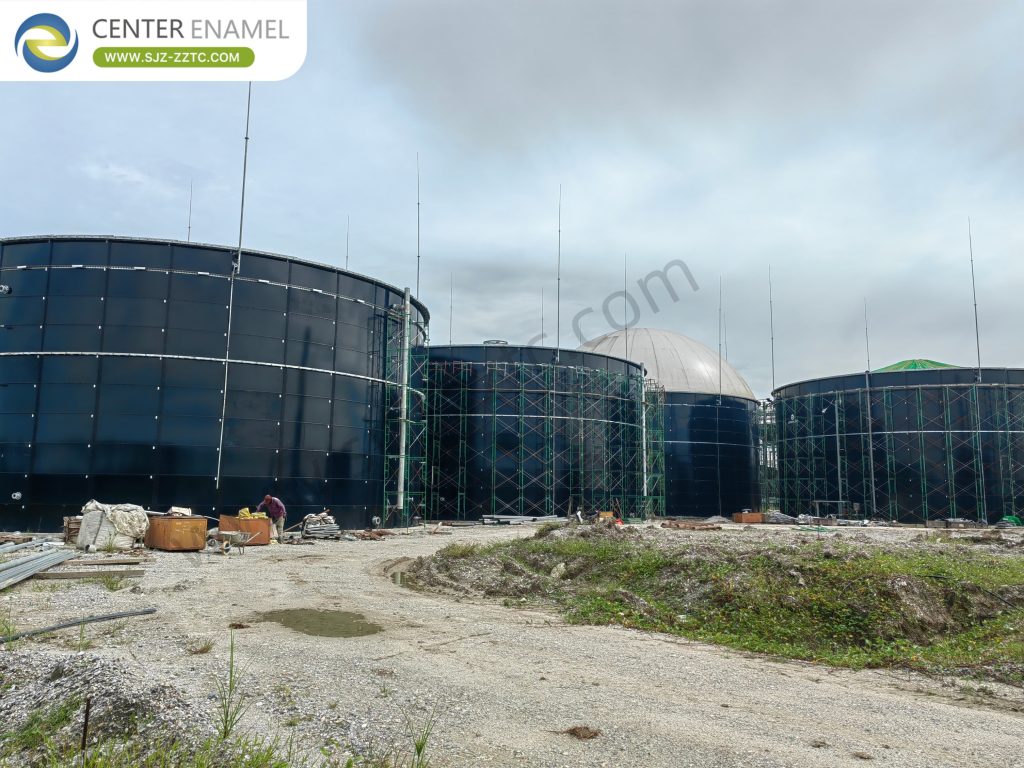
In any large-scale biogas or organic waste treatment facility, structural containment is paramount. The digesters, buffer tanks, and digestate storage units must endure aggressive chemical environments, volatile fatty acids, and continuous pressure variations. This is why Glass-Fused-to-Steel (GFS) storage tanks have become the premier choice for modern waste-to-energy infrastructure.
GFS tanks are manufactured by fusing specialized glass enamel to high-strength structural steel plates at extreme temperatures between 820°C and 930°C. This permanent thermal fusion marries the structural strength of steel with the supreme corrosion resistance of glass.
Key Advantages of GFS Tanks in Biogas Applications:
Superior Corrosion Resistance: GFS surfaces withstand harsh acidic and alkaline environments (pH range 3–11), protecting the structure from corrosive digestate and chemical interactions.
Rapid Modular Installation: Bolted GFS panels are assembled quickly on-site, dramatically shortening construction schedules compared to traditional concrete tanks.
Extended Service Life: The ultra-smooth glass coating prevents biological scaling and sediment buildup, ensuring a maintenance-free lifespan exceeding 30 years.
Weather and UV Resilience: GFS tanks resist fading, cracking, and extreme weather, maintaining a professional aesthetic for municipal utility sites.
Center Enamel: Your Trusted Partner for Turnkey Biogas Solutions with Decades of Experience
Executing complex solid waste-to-energy and biogas infrastructure projects requires elite engineering capabilities and world-class manufacturing standards. Center Enamel has earned an exceptional global reputation as a premier manufacturer and comprehensive project service provider in the environmental engineering sector.
Backed by decades of industry experience, Center Enamel specializes in the research, development, and production of high-end bolted steel tanks, including GFS tanks, fusion bonded epoxy tanks, and stainless steel tanks. Beyond manufacturing elite containment vessels, Center Enamel delivers integrated EPC (Engineering, Procurement, and Construction) solutions for biogas engineering, organic waste treatment, and wastewater management.
Why Global Clients Choose Center Enamel:
State-of-the-Art Manufacturing: Operating advanced production lines equipped with cutting-edge enameling and robotic welding technology to guarantee uncompromising product quality.
Global Engineering Expertise: A seasoned team of professional engineers capable of tailoring custom CSTR and GFS containment solutions to meet stringent international standards (such as ISO, AWWA, and OSHA).
Proven Track Record: Thousands of successful municipal, agricultural, and industrial biogas projects operating reliably across dozens of countries worldwide.
Comprehensive Project Support: Providing end-to-end assistance from initial feasibility studies and custom design to on-site installation, commissioning, and after-sales service.
Frequently Asked Questions (FAQs) About Solid Waste Biogas Management
Q1: What types of solid waste can be converted into biogas?
Biodegradable organic fractions are suitable for biogas production. This includes food waste from households and restaurants, agricultural residues, animal manure, yard trimmings, and certain organic industrial byproducts from food and beverage processing facilities.
Q2: Why is anaerobic digestion better than landfilling for organic waste?
Anaerobic digestion takes place inside sealed, engineered vessels, allowing complete capture of methane for renewable energy generation while producing a valuable organic fertilizer. Landfilling, by contrast, releases fugitive methane emissions into the atmosphere and creates toxic leachate that endangers groundwater supplies.
Q3: How long do GFS storage tanks last in a biogas plant?
Glass-Fused-to-Steel (GFS) tanks are engineered for exceptional longevity, typically providing a service life of 30 years or more. The permanent fusion of glass and steel creates an impenetrable barrier against corrosive digestate, organic acids, and harsh weather conditions, ensuring maximum return on investment.